
G-Code vs M-Code: Understanding Their Roles in CNC Machines
CNC machining is at the heart of modern manufacturing. From precision automotive components to heavy industrial brackets and structural parts, CNC machines allow manufacturers to produce consistent, accurate parts at scale. These machines follow detailed instructions generated by computer programs, and those instructions determine everything from how the tool moves to when the spindle starts spinning.
At the core of every CNC program are two essential types of commands: G-code and M-code. While they are often mentioned together, they serve very different purposes inside the machine. Understanding how they work and how they work together is fundamental for operators, programmers, engineers, and production managers.
This guide explains their roles clearly, without unnecessary technical complexity.
Understanding the Foundation of CNC Programming
CNC stands for Computer Numerical Control. Instead of manually operating machinery with handwheels and levers, CNC machines are controlled by programmed numerical instructions. These instructions guide the machine step by step through a machining process.
Every CNC program is made up of a sequence of coded commands. Some commands control movement and positioning, while others control machine operations such as spindle rotation or coolant flow. Together, they create a structured process that transforms raw material into a finished component.
The two main types of commands used in this process are:
- G-codes – which control tool movement and cutting paths
- M-codes – which control machine functions and operational behavior
Although both appear throughout a CNC program, their responsibilities are clearly divided. Learn more in the complete guide to CNC Machining Programming Software.
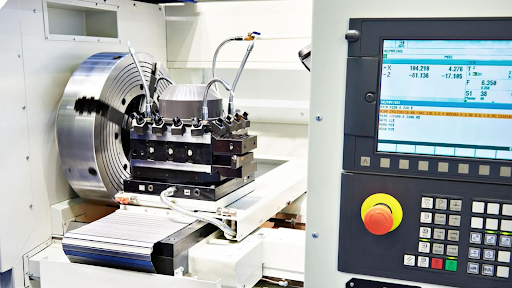
What Is G-Code?
G-code is the primary language used to control the movement of a CNC machine. The “G” typically stands for geometry or general function, because it defines how the tool moves in relation to the workpiece.
When machining a part, the cutting tool must follow an exact path. That path determines the final shape, size, and accuracy of the component. G-code provides the instructions for that movement.
It controls:
- Linear movement (straight lines)
- Circular interpolation (arcs and curves)
- Positioning moves
- Feed rate during cutting
- Depth of cut
For example, when a machine mills a straight edge, G-code tells the tool where to start, where to stop, and how fast to move. If the part requires a curved surface, G-code calculates and defines the arc motion.
A typical G-code command might look like this:
G01 X50 Y25 F100
This tells the machine to move in a straight line (G01) to position X50 and Y25 at a feed rate of 100. The machine reads this instruction and moves accordingly.
Without G-code, the CNC machine would not know how to shape the material. It would have no direction or geometry to follow. In simple terms, G-code defines the physical form of the finished part.
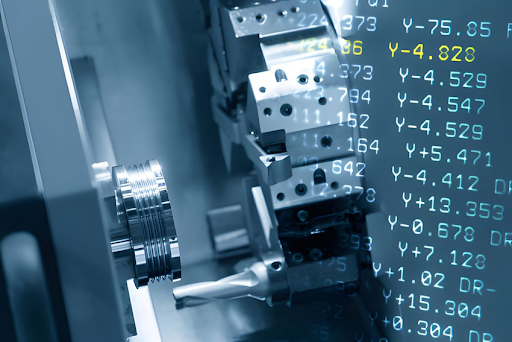
What Is M-Code?
While G-code controls movement, M-code controls the machine’s operating functions. The “M” commonly stands for machine or miscellaneous function.
M-code commands do not move the tool along a path. Instead, they control the supporting actions that allow machining to take place. These include starting and stopping the spindle, turning coolant on or off, and changing tools.
Common M-code functions include:
- Spindle start (clockwise or counterclockwise)
- Spindle stop
- Coolant on
- Coolant off
- Tool change
- Program stop or end
For example, before any cutting can begin, the spindle must rotate. An M-code command activates the spindle. Once cutting is complete, another M-code stops it.
If coolant is required to prevent overheating during cutting, an M-code activates the coolant system. When the operation ends, a separate M-code shuts it off.
In short, M-code manages how the machine behaves, while G-code manages how the tool moves.
The Core Difference Between G-Code and M-Code
Although they appear together in CNC programs, G-code and M-code serve clearly different roles.
The difference can be summarised simply:
- G-code controls motion and geometry
- M-code controls machine operations and auxiliary functions
If you imagine the CNC machine as a vehicle, G-code is responsible for steering and controlling the direction of travel. M-code is responsible for turning the engine on, switching systems on or off, and managing operational controls.
A machining operation cannot be completed using only one type of code. Movement without spindle rotation produces no cutting. Spindle rotation without movement produces no shape. Both must work together to complete the task.
G-Code vs M-Code Comparison Table
| Feature | G-Code | M-Code |
| Full Meaning | Geometry Code / General Function Code | Machine Code / Miscellaneous Function Code |
| Main Purpose | Controls tool movement and cutting paths | Controls machine operations and auxiliary functions |
| What It Manages | Position, direction, feed rate, arcs, drilling cycles | Spindle control, coolant, tool changes, program start/stop |
| Focus Area | Part geometry and machining accuracy | Machine behavior and operational control |
| Affects | Shape and dimensions of the final part | Machine performance and process safety |
| Used For | Linear moves, circular moves, rapid positioning | Spindle ON/OFF, coolant ON/OFF, tool change, program end |
| Example Command | G01 X50 Y25 F100 | M03 (Spindle ON) |
| Type of Control | Motion control | Operational control |
How G-Code and M-Code Work Together in Practice
In a real machining program, G-code and M-code are interwoven throughout the sequence.
Consider a simple milling operation. Before the tool touches the material, the machine must start the spindle. This is done using M-code. Immediately after, G-code positions the tool above the workpiece. Once the tool is in place, G-code commands the tool to move downward into the material at a controlled feed rate.
At the same time, another M-code may activate coolant to control temperature and improve tool life. As the machining continues, multiple G-code commands shape the part through precise movement. When the operation is complete, M-code stops the spindle and ends the program safely.
This interaction ensures:
- The machine operates safely
- The tool follows the correct cutting path
- Supporting systems function at the right time
The program becomes a coordinated sequence where movement and machine behavior are perfectly synchronized.
Why Both Codes Are Critical for Accuracy and Safety
In CNC manufacturing, precision is everything. A small programming error can lead to incorrect dimensions, wasted material, or damaged tooling.
Errors in G-code typically affect the geometry of the part. If coordinates are incorrect or feed rates are miscalculated, the final component may not meet specifications. This can result in rejected parts or costly rework.
Errors in M-code, on the other hand, often affect machine performance and safety. If the spindle does not start, cutting cannot occur. If coolant does not activate when required, tools may overheat and wear prematurely. If the program does not end correctly, the machine may not reset properly for the next job.
Because of this, understanding both codes is not just about programming efficiency it is also about operational reliability and workplace safety.
Differences Across CNC Control Systems
Most CNC machines use a standard form of G-code and M-code. However, slight variations may exist between manufacturers such as Fanuc, Haas, Siemens, or Mazak.
While the core commands remain largely consistent, some machines include additional custom codes or slightly different formats. For this reason, operators should always review the specific control manual before running a new program.
Despite minor differences, the fundamental structure remains unchanged: G-code manages motion, and M-code manages machine functions.
Also read What is a CNC Drilling Machine? Complete Guide for Fabricators.
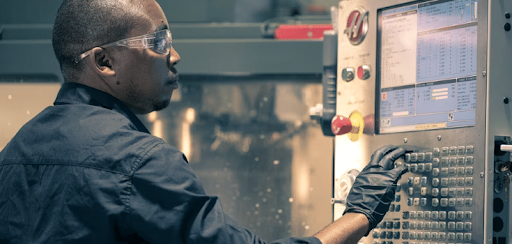
The Role of Modern CAD/CAM Software
Today, many workshops rely on CAD/CAM software to generate CNC programs automatically. Engineers design parts digitally, and the software converts those designs into G-code and M-code instructions.
Although automation has simplified programming, understanding the basics remains important. Operators often need to adjust feed rates, edit tool paths, or troubleshoot errors directly in the code. Without knowledge of how G-code and M-code function, diagnosing problems becomes difficult.
Even with advanced automation, these codes remain the core language that CNC machines understand.
Why Choose Kirmell for Precision CNC Machining?
At Kirmell, we deliver high-precision CNC machining services backed by expert programming and advanced manufacturing technology. Our team understands the importance of accurate G-code and M-code control to ensure consistent movement, reliable machine performance, and tight tolerances across every project.
From one-off prototypes to large production runs, we manufacture durable, high-quality metal components designed for demanding industrial environments. With a strong focus on precision, efficiency, and quality control, Kirmell provides dependable CNC solutions you can trust.
Conclusion
G-code and M-code form the backbone of CNC machining. They serve different purposes but work together in every successful machining operation.
G-code defines the movement and geometry of the cutting tool, shaping raw material into precise components. M-code controls the machine’s operational functions, ensuring that spindles rotate, coolant flows, and programs run safely from start to finish.
The relationship between the two is not competitive but complementary. Movement without machine control is ineffective, and machine control without movement achieves nothing. Together, they create a complete and reliable system that powers modern manufacturing.
For anyone involved in CNC operations whether as a programmer, operator, engineer, or manufacturing business owner understanding the difference between G-code and M-code is essential. Mastering their roles leads to better accuracy, improved efficiency, reduced downtime, and safer machining processes.
FAQs
Can G-code and M-code vary depending on the CNC machine brand?
How do CNC machines interpret G-code and M-code?
What happens if there is an error in the code?
Are G-code and M-code used only for milling machines?
Do I need to learn manual coding if I use CAM software?
How can G-code and M-code affect machining time?
Is it possible to customize M-codes?