
Nitrogen vs Oxygen in Laser Cutting: What’s the Difference?
Laser cutting looks simple from the outside: a focused beam melts metal and a jet of gas blows the melt away. But in real production, the assist gas is just as important as the laser itself. It affects cut speed, edge colour, surface cleanliness, dross levels, and how much work you’ll do after cutting (deburring, grinding, welding prep, painting prep).
Two gases dominate metal laser cutting: oxygen (O₂) and nitrogen (N₂). They don’t just “push the melt out” they change the chemistry and heat balance inside the cut. That’s why the same laser can produce very different results depending on which gas you choose.
This guide explains the difference in a straightforward way and helps you pick the right gas for your job.
Why Assist Gas Matters in Laser Cutting
When a laser cuts metal, it creates a narrow channel called the laser kerf. Inside that kerf, metal melts (and sometimes partially vaporises). The assist gas flowing through the nozzle helps in three main ways:
- Blows molten metal out of the kerf, allowing the laser to continue cutting.
- Controls oxidation by either allowing oxygen to react or pushing oxygen away.
- Stabilises cut quality by influencing heat, dross, and edge finish.
The biggest difference between oxygen and nitrogen is simple:
- Oxygen reacts with hot metal and adds extra heat.
- Nitrogen doesn’t react and helps keep the edge clean.
That one idea explains most of what you see in the finished part. Let’s discuss this in more detail.
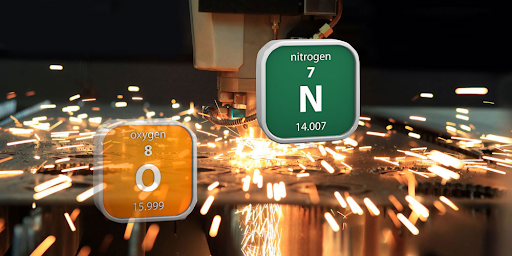
Oxygen Laser Cutting: Reactive Cutting That Boosts Speed
How oxygen helps the cut
Oxygen is a reactive gas. In the laser cutting process, when a laser heats steel and oxygen contacts the hot surface, oxidation occurs. Oxidation releases extra heat (an exothermic reaction). Think of it as a controlled “assist burn” that works alongside the laser beam.
Because oxygen adds heat, it can:
- Increase cutting efficiency on many steels
- Improve cutting performance on thicker mild steel
- Allow higher speeds in common carbon steel work
What oxygen-cut edges look like
The trade-off is oxidation. Oxygen cutting usually leaves:
- Darker edges
- Oxide scale
- Sometimes more visible heat tint
This oxide isn’t only cosmetic. If the part needs painting, powder coating, or welding, you often need to remove that oxide first. Otherwise, it can affect surface bonding, coating adhesion, and weld consistency (depending on the application and quality requirements).
When oxygen is commonly used
Oxygen is most commonly used for:
- Mild steel/carbon steel
- Jobs where speed and throughput matter more than a bright edge finish
- Parts that will be processed later anyway (grinding, machining, shot blasting, etc.)
Nitrogen Laser Cutting: Inert Cutting For Clean, Bright Edges
How nitrogen works
Nitrogen is typically treated as an inert assist gas in laser cutting. It does not add heat through chemical reaction, the way oxygen does. Instead, it mainly works by:
- Shielding the cut zone from oxygen in the air
- Forcefully ejecting molten metal from the kerf
Because nitrogen reduces oxidation, it tends to produce a cleaner cut edge.
What nitrogen-cut edges look like
Nitrogen cutting usually results in:
- Bright, metallic edges
- Minimal oxide layer
- Less need for post-cut edge cleaning (especially for finishing work)
For many industries, this is the key advantage: parts come off the laser looking cleaner and requiring less prep for the next step.
When nitrogen is commonly used
Nitrogen is widely used for:
- Stainless steel
- Aluminium
- Decorative, visible parts where edge appearance matters
- Parts that go straight to welding, coating, or assembly and need clean edges
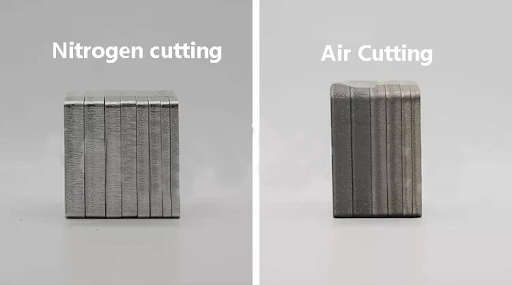
The Real Difference Between Nitrogen and Oxygen in Laser Cutting (Speed vs Edge Finish)
The main difference between nitrogen vs oxygen in laser cutting is simple: oxygen increases cutting speed, while nitrogen improves edge quality.
Oxygen laser cutting is commonly used for mild steel because it reacts with the hot metal and adds extra heat. This helps the laser cut faster and handle thicker steel more efficiently. However, this reaction creates an oxide layer (scale) on the cut edge, leaving it darker and sometimes requiring cleaning before welding or painting.
Nitrogen laser cutting, on the other hand, does not react with the metal. It protects the cut from oxidation, producing bright, clean, scale-free edges. This makes it ideal for stainless steel, aluminium, and parts that need a high-quality finish. The trade-off is that nitrogen usually requires higher gas pressure and can cost more to run.
In short: Oxygen = faster cutting but oxidised edges. Nitrogen = cleaner edges but higher operating cost.
Also read Fibre vs CO2 laser cutting and the key differences between them.
Side-by-side comparison: Nitrogen vs Oxygen Laser Cutting
1) Edge finish and colour
Nitrogen:
- Bright edge finish
- Minimal oxidation
- Better when the cut edge will remain visible or needs a clean finish
Oxygen:
- Darker edges
- Oxide layer present
- May need cleaning before welding or painting
2) Speed and thickness capability (especially on mild steel)
Oxygen:
- Often faster on mild/carbon steel
- Oxidation adds heat, helping the process
- Good for thicker sections when productivity is a priority
Nitrogen:
- No extra heat from reaction
- Speed depends more on laser power and gas flow effectiveness
- Often preferred when quality and finish are the priority
3) Post-processing effort
Nitrogen:
- Typically less edge cleaning
- Less oxide means quicker finishing steps
- Helpful for powder coating and welding prep
Oxygen:
- Oxide removal may be needed
- Extra steps can include brushing, grinding, deburring, or dedicated oxide removal
- Total production time can increase if you need a premium finish
4) Gas pressure and setup behaviour
This is where many operators notice the biggest practical difference.
Nitrogen generally runs at higher pressures because the gas must do more “physical work” (blowing the melt away and keeping oxygen out).
Oxygen often runs at lower pressure because the chemical reaction contributes energy and helps sustain cutting.
That doesn’t mean one is always easier than the other — it just means the “tuning knobs” behave differently.
5) Cost: don’t compare gas prices only
It’s easy to compare oxygen vs nitrogen by looking at gas cost alone, but the smarter comparison is:
- Cut time (speed / throughput)
- Gas consumption (pressure and flow)
- Post-processing time (oxide removal or not)
- Rejects and rework risk
- Downstream impact (weld prep and coating quality)
In many mild steel jobs, oxygen can be cheaper overall because it cuts faster. In many stainless/aluminium or cosmetic jobs, nitrogen can be cheaper overall because it reduces secondary operations.
Which Gas is Best Choice For Different Materials?
Mild steel/carbon steel
Most common choice: Oxygen
Why it’s common:
- Faster cutting in many thickness ranges
- Better productivity for typical steel fabrication
When nitrogen may be better on mild steel:
- When edges must be clean for coating or welding
- When you want less scale and less cleanup
- When surface finish matters to the customer
Stainless steel
Most common choice: Nitrogen
Why it’s common:
- Stainless steel is often cut for appearance and corrosion resistance
- Nitrogen minimises oxidation and discolouration
- Cleaner edges reduce finishing time
Oxygen can cut stainless steel, but it usually causes more discolouration and oxidation, which many stainless applications don’t allow.
Aluminium
Most common choice: Nitrogen
Why it’s common:
- Aluminium oxidises quickly
- Nitrogen helps keep edges cleaner
- High-pressure nitrogen improves ejection and reduces dross in many setups
Practical Decision Guide: When to Use Oxygen vs Nitrogen in Laser Cutting
Choosing between oxygen and nitrogen in laser cutting depends on what matters most for your job: speed or finish quality.
Choose oxygen when cutting mild or carbon steel if your priority is high speed and productivity. Oxygen helps the laser cut faster, especially on thicker steel. It’s a good option when slight oxidation at the edge is acceptable, or when parts will be cleaned, machined, or otherwise processed.
Choose nitrogen when you need bright, oxide-free edges and a cleaner finish. It is ideal for stainless steel and aluminium, or when parts go straight to welding, painting, or powder coating. Nitrogen is the better choice when appearance, edge quality, and consistency are more important than maximum cutting speed.
| Feature | Oxygen (O₂) Assist Gas | Nitrogen (N₂) Assist Gas |
| Cutting type | Reactive cutting (oxidation adds heat) | Inert cutting (no reaction, shields from oxidation) |
| Best for | Mild / carbon steel | Stainless steel, aluminium, cosmetic/finished parts |
| Cutting speed | Faster on mild steel | Usually slower than oxygen on mild steel |
| Edge colour | Darker edge, heat tint common | Bright, clean metallic edge |
| Oxide/scale on edge | Yes, oxide layer/scale forms | Minimal to none (oxide-free finish) |
| Post-processing | Often needs cleaning/grinding for welding/coating | Less cleanup; better straight to finishing |
| Welding readiness | May require oxide removal first | Better for welding due to clean edge |
| Painting/powder coating | Prep often needed due to oxide | More coating-friendly with minimal prep |
| Gas pressure (typical) | Lower | Higher |
| Running cost (typical) | Often lower gas cost | Often higher due to higher pressure/usage |
| Main advantage | High productivity on mild steel | Best edge quality and finish consistency |
| Main drawback | Oxidation/scale and extra finishing work | Higher gas consumption and operating cost |
Common Errors and How to Avoid Them
Mistake 1: Choosing oxygen for speed, then losing time in cleanup
If the job ends up needing heavy grinding or oxide removal, the faster cut speed can be cancelled out by slow finishing steps. Always consider the full process.
Mistake 2: Using nitrogen but not controlling pressure/purity
If nitrogen pressure is too low (or the supply quality isn’t consistent), you may see discolouration or more dross. Nitrogen cutting depends heavily on stable gas delivery.
Mistake 3: Treating assist gas as a “fixed rule”
The best gas choice can change depending on:
- thickness
- required edge appearance
- whether the part is welded
- whether it’s painted/coated
- delivery deadlines and cost targets
Advanced Laser Cutting Solutions from Kirmell
At Kirmell, we provide precision CNC fibre laser cutting services for mild steel, stainless steel, and aluminium, delivering clean, accurate cuts tailored to your project requirements. Whether your job demands high-speed oxygen cutting for cost-effective mild steel production or nitrogen cutting for bright, oxide-free stainless edges, our team selects the right process to ensure the best balance of quality, efficiency, and finish. We work with businesses across construction, manufacturing, fabrication, and bespoke metal projects.
From one-off prototypes to large production runs, Kirmell focuses on consistency, tight tolerances, and fast turnaround times. Our advanced laser cutting technology ensures smooth edges, minimal waste, and reliable results every time. Looking for professional laser cutting you can depend on? Contact Kirmell today for a fast quote and expert advice on your next project
Conclusion
Nitrogen and oxygen both play important roles in laser cutting, but they deliver different results. Oxygen increases cutting speed on mild steel by adding extra heat through oxidation, making it ideal for productivity-focused jobs. However, it leaves oxide scale on the cut edge.
Nitrogen prevents oxidation and produces bright, clean edges with better finish quality. It usually requires higher gas pressure and can cost more to run, but it reduces post-processing. If speed matters most, choose oxygen; if edge quality matters most, choose nitrogen
FAQs
Can you use oxygen for stainless steel laser cutting?
Does nitrogen always produce a perfect, burr-free edge?
Is one gas safer than the other in laser cutting?
Does gas choice affect part accuracy or tolerances?
Can switching gases reduce overall production time?