
Custom Pallets: When Standard Pallets Aren’t Enough
A standard pallet works well, until your product doesn’t fit it. An unusual shape, extra weight, or specific handling requirement can quickly turn a simple pallet into a costly problem.
That’s where custom pallets come in. Instead of forcing your product to fit a standard design, a custom pallet is built around the exact dimensions, weight, handling and storage needs of your application.
From oversized loads and awkward-shaped components to specialised stacking and handling requirements, bespoke designs can offer a more practical solution where standard pallets fall short.
In this guide, we’ll explore when custom pallets make sense, what to consider when designing one, and how a bespoke pallet can improve handling, storage and load stability.
What Are Custom Pallets?
Custom pallets are pallets designed and built to meet the specific needs of a product, load or handling system. Unlike standard pallets, they are not limited to common sizes or fixed configurations.
A standard pallet is designed for general use. It works well when your products fit its dimensions, weight capacity and handling requirements. But not every load follows a standard format.
Manufacturers may need a custom pallet when they handle oversized, unusually shaped or heavy products. A bespoke design can also help when a pallet needs to work with specific forklifts, storage systems or production equipment, particularly when stillage design needs to account for specific handling and storage requirements.
When Do You Need a Custom Pallet?
Not every load is a good match for a standard pallet. If your products regularly create problems with sizing, weight, handling, stacking or protection, a custom pallet may be a better solution.
1. Your Load Doesn’t Fit Standard Pallet Dimensions
Standard pallet sizes work well for products that fit neatly within their footprint. But oversized or unusually shaped products may extend beyond the pallet edges, creating unnecessary overhang.
A custom pallet can be designed to match the dimensions of the load more closely. This can provide better support and make more effective use of the available pallet space.
2. Your Load Has Specific Weight or Load Distribution Requirements
Heavy loads are not always difficult simply because of their total weight. A load with concentrated weight in one area can place more stress on certain parts of the pallet.
Uneven weight distribution can also affect stability during handling and storage. A custom pallet can be designed around the actual weight, load distribution and support points of the product.
3. Your Product Has an Unusual Shape
Some products simply do not sit securely on a standard flat pallet. Irregular components, long products and awkward-shaped items may need additional support to remain stable.
A custom design can include dedicated supports or positioning features that match the shape of the product. This helps keep the load properly positioned during handling and transport.
4. Standard Pallets Don’t Suit Your Handling Equipment
Your pallet also needs to work with the equipment used to move it. Forklifts, pallet trucks, conveyors and automated handling systems may have specific access and clearance requirements.
A custom pallet can be designed with the right entry points, clearances and dimensions for your handling system. This can make loading, moving and positioning the pallet more straightforward.
5. You Need Specific Stacking or Nesting Requirements
Storage requirements can also make a standard pallet unsuitable. If pallets need to be stacked to a particular height or stored efficiently in a limited space, their design and geometry become important.
Custom pallets can be developed around specific stacking or nesting requirements. This can improve stability, maximise available warehouse space and support repeated handling.
6. Your Products Need Additional Protection
Some products need more than a flat surface for safe handling. Components may need to be held in a specific position or prevented from shifting during transport.
Custom pallets can incorporate locating features, supports and retaining elements to suit the product. These features can help reduce unwanted movement and provide more secure support throughout handling and transport.
What Should You Consider When Designing a Custom Pallet?
Designing a custom pallet is not simply about choosing a different size. The pallet needs to work safely and efficiently with the product, handling equipment and storage environment. Considering the following factors early can help create a design that meets the demands of your application.
1. Load Dimensions and Weight
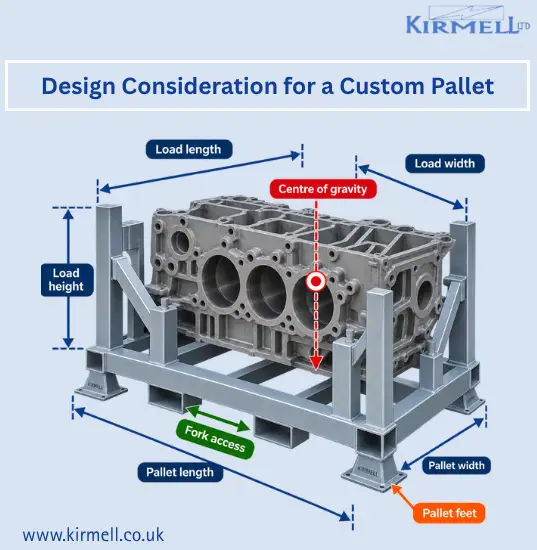
Start with the basic details of the load. Measure its length, width and height, and determine its total weight. The pallet should provide adequate support across the load without unnecessary overhang.
Knowing the exact dimensions and weight also helps determine the appropriate pallet size and construction, as well as the pallet feet size required for the finished design.
2. Load Distribution and Centre of Gravity
Two loads with the same weight can place very different demands on a pallet. A concentrated or uneven load may put more stress on specific areas of the structure. Consider where the weight sits and where the centre of gravity is located.
This information helps ensure the pallet provides stable support and remains balanced during handling, which is particularly important when considering warehouse load stability.
3. Fork Access and Handling Requirements
Think about how the pallet will be moved throughout its working life. Will it be handled by a forklift, pallet truck, conveyor or automated system? The pallet should provide suitable entry points and clearances for the equipment being used.
Getting this right from the design stage can make handling safer and more efficient, particularly when pallets need to integrate with automated handling systems.
4. Stacking and Storage Requirements
If pallets will be stacked, consider the required stack height, load stability and available warehouse space. For applications where empty pallets need to be stored efficiently, nesting may also be important.
The pallet’s geometry can be designed to support the required stacking or nesting arrangement, helping improve warehouse storage efficiency where space is limited.
5. Pallet Feet and Leg Configuration
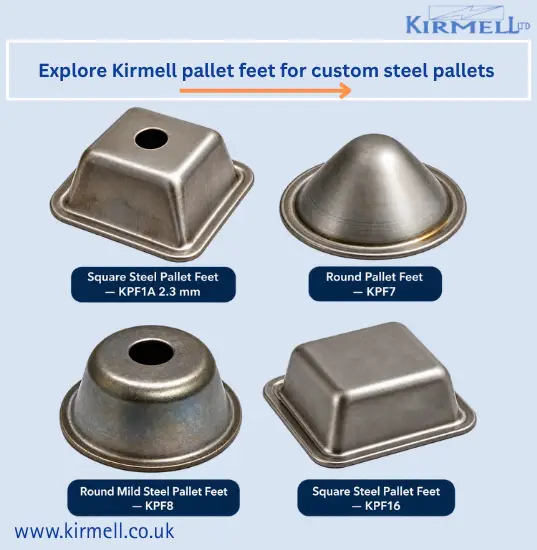
Pallet feet or legs affect the pallet’s clearance, stability and interaction with handling equipment. Choosing the right pallet feet for steel pallets and stillages is therefore an important part of the overall pallet design.
Their position and configuration should therefore be considered as part of the overall pallet design, with options such as round and square pallet feet offering different configurations for industrial applications.
Kirmell supplies a range of pallet feet designed for steel pallets and industrial applications, helping manufacturers select a suitable configuration for their specific requirements.
6. Material and Construction
The material and construction method should match the demands placed on the pallet, particularly when choosing between different metal fabrication methods for a bespoke industrial design.
Consider the required strength, weight, durability and any features that need to be incorporated into the design. For industrial applications, the construction should be suitable for the expected load and repeated handling conditions.
7. Operating Environment
Where will the pallet be used? Indoor warehouses, outdoor storage areas, manufacturing facilities and transport environments can place different demands on a pallet.
Consider factors such as exposure to moisture, temperature, chemicals, impact and other conditions that could affect its performance., as these factors can also influence the choice between ferrous and non-ferrous metals.
Expected Usage and Service Life
Finally, consider how often the pallet will be used and how long it needs to last. A pallet used once for transport has different requirements from a returnable pallet that will be handled repeatedly.
Understanding the expected service life helps determine the appropriate construction, durability and level of reinforcement for the application.
Custom Pallets vs Standard Pallets
Standard pallets are a practical choice for many businesses because they are widely available, familiar to handling teams and generally cost less. But when your load or handling process has specific requirements, a custom pallet can provide a better fit.
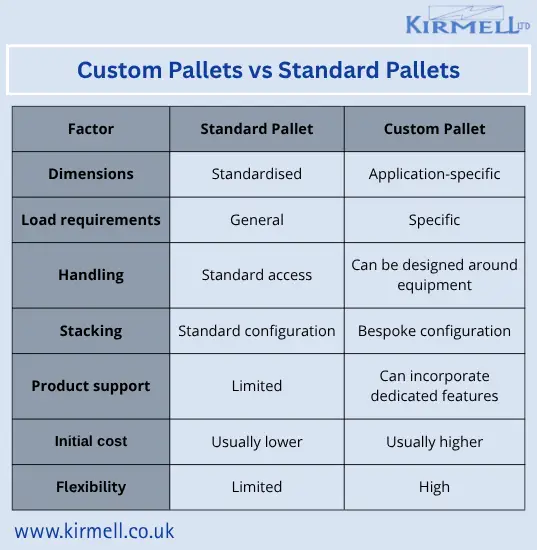
The main advantage of a standard pallet is simplicity. If your products fit comfortably within standard dimensions and your existing handling equipment works well, there may be little reason to choose a bespoke design.
A custom pallet becomes more valuable when a standard design creates operational problems, much like the choice between custom and standard metal fabrication depends on the requirements and budget of the application.
For example, an oversized load may overhang the pallet, an uneven load may need additional support, or specific handling equipment may require different access points.
Although custom pallets can have a higher initial cost, the additional design work may be justified when it improves load stability, handling efficiency, storage, product protection or space utilisation.
The right choice therefore depends on the application. If a standard pallet meets your requirements safely and efficiently, it may be the most practical option. If it does not, a custom design can provide a solution built around the way your products are actually handled.
Benefits of Custom Pallets
A well-designed custom pallet can do more than simply carry a load. It can improve how products are handled, stored and transported throughout the supply chain.
- Better product fit: Designed around the product’s exact dimensions, helping provide proper support without unnecessary overhang.
- Improved load stability: A design based on the actual load can help keep products balanced and secure during handling.
- More efficient storage: Custom dimensions, stacking or nesting configurations can help make better use of available warehouse space, particularly when pallet feet and nesting plugs are selected to support efficient storage.
- Easier material handling: Pallets can be designed around forklifts, pallet trucks and other equipment used in your operation.
- Reduced product damage: Dedicated supports and positioning features can help prevent products from shifting or being damaged during handling and transport.
- Better use of transport space: A pallet designed around the load can help reduce wasted space and improve how products are arranged for transport.
- Integration with existing handling systems: Custom pallets can be designed to work with conveyors, automated handling equipment and other systems already used in your facility.
Custom Pallets for Different Industrial Applications
Custom pallets are particularly useful when the product, load or handling process does not fit a standard pallet design. Different industries may need bespoke solutions for very different reasons.
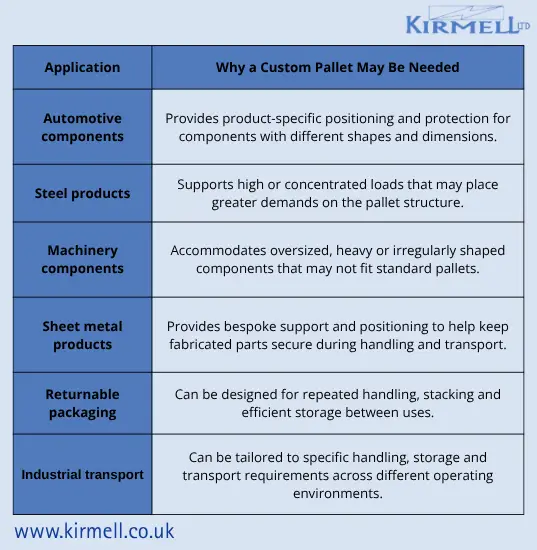
The key is to design the pallet around the actual application, rather than trying to adapt a standard pallet to a load it was not designed to handle.
When Is a Custom Pallet Worth It?
A custom pallet is worth considering when a standard pallet cannot properly meet the requirements of your product, handling process or storage system.
The additional design and manufacturing work can be justified when it solves practical problems that a standard pallet cannot. You may need a custom pallet if:
- Your product has unusual dimensions or an irregular shape
- The load requires specific support or positioning
- A standard pallet cannot safely handle the required weight
- Forklift or handling access is limited
- Products need additional protection during handling or transport
- Standard pallets do not stack or nest efficiently
- You need to make better use of warehouse or transport space
- The pallet will be reused regularly for the same application
The key question is not simply whether a custom pallet costs more. It is whether the design can improve handling, storage, product protection and overall efficiency enough to justify the investment.
FAQs
Custom pallets can cost more than standard pallets because they require additional design and manufacturing work. However, the higher initial cost may be justified if the pallet improves product protection, storage efficiency, handling or transport.
Yes. Custom pallets can be designed around the weight and load distribution requirements of the application. Factors such as construction, support points, dimensions and pallet feet can be considered to create a suitable design for demanding loads.
Important considerations include the product’s dimensions and weight, load distribution, centre of gravity, forklift access, stacking requirements, pallet foot configuration, construction materials, operating environment and expected service life.
Pallet feet provide support between the pallet and the floor or another pallet. Their configuration can affect stability, stacking, handling and load distribution. Kirmell supplies pallet feet for steel and industrial pallet applications, helping manufacturers choose suitable feet for their specific pallet design and handling requirements.
Conclusion
Standard pallets work well for many applications, but they are not suitable for every load. When dimensions, weight, shape, handling or storage requirements fall outside standard specifications, a custom pallet can provide a more practical solution.
The best approach is to design the pallet around the application rather than forcing the product to fit a standard design. The right dimensions, load support, access points and pallet foot configuration can make a significant difference to how safely and efficiently the pallet performs.
If your current pallet is causing problems with load stability, handling, stacking or storage, it may be worth considering a bespoke design. Choosing the right pallet components and feet at the design stage can also help create a more reliable solution for repeated industrial use, particularly when selecting heavy-duty pallet feet for high loads.

