
Steel Pallets: Types, Benefits & Industrial Applications
When loads get heavier, handling gets tougher, and pallets need to last for years, wood and plastic do not always make the cut. This is why many industries are turning to steel pallets for demanding storage, handling and transport applications.
A steel pallet is a reusable load-carrying platform made from steel, designed to support, move and store goods safely. Unlike conventional pallets, steel designs can offer greater strength, durability and resistance to impact, making them suitable for challenging industrial environments.
But steel pallets are not all the same. From flat and post pallets to heavy-duty, stainless steel and bespoke designs, each type serves a different purpose. In this guide, we’ll explore the main types of steel pallets, their key benefits, and where they are used across industries such as automotive, manufacturing, construction, warehousing and logistics.
What Are Steel Pallets?
Steel pallets are reusable platforms made from steel that are used to store, handle and transport goods. They are designed for applications where pallets need to withstand heavy loads, repeated handling and demanding working conditions.
Most metal pallets used in industrial applications are made from mild steel or carbon steel, while stainless steel is used where higher corrosion resistance and hygiene are important. The choice of material depends on the environment, load and intended use.
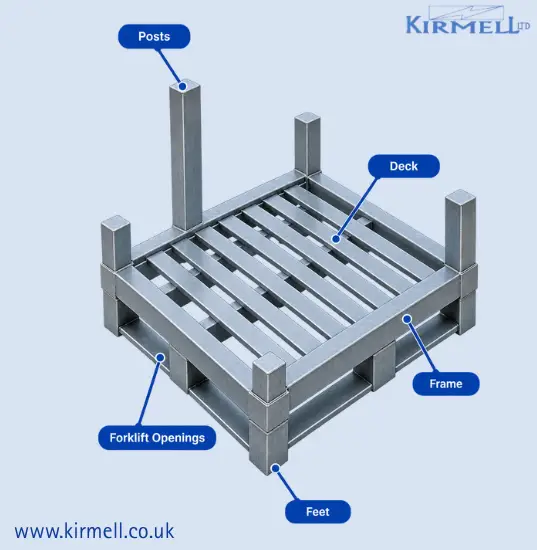
A typical steel pallet may include:
- Deck: The top surface that supports the load.
- Frame: Provides the main structural support.
- Pallet Feet: Support the pallet and allow stable stacking.
- Posts: Used on post pallets to contain or support loads.
- Forklift openings: Provide access for forklifts and pallet trucks.
The way these components are designed directly affects the pallet’s strength, stability and load capacity, particularly when pallets are stacked or moved.
For example, reinforced frames can handle heavier loads, while properly designed feet help distribute weight and keep stacked pallets stable. The deck design also influences how evenly the load is supported and how easily the pallet can be handled.
Types of Steel Pallets
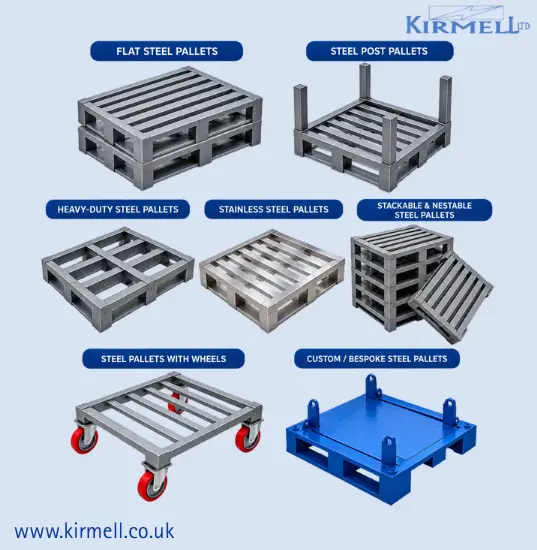
Steel pallets come in different designs to suit different loads, handling methods and working environments. Choosing the right type depends on factors such as load weight, available storage space, stacking requirements and how the pallet will be moved.
1. Flat Steel Pallets
Flat steel pallets have a simple deck and supporting frame for general storage, transport and handling. They are easy to move with forklifts and pallet trucks and can have open or solid decks.
2. Steel Post Pallets
Steel post pallets have upright posts that support and contain loads. They are ideal for long or bulky materials such as pipes, timber, scaffolding and automotive components. Posts can be fixed or removable.
3. Heavy-Duty Steel Pallets
Heavy-duty steel pallets use reinforced frames and stronger steel sections and heavy-duty pallet feet to carry heavier loads and withstand repeated industrial use. They are commonly used in manufacturing, engineering and automotive applications.
4. Stainless Steel Pallets
Stainless steel pallets offer high corrosion resistance and easy cleaning, making them suitable for food, pharmaceutical and healthcare environments. 304 is suitable for general use, while 316 provides greater resistance to chemicals and salt. Steel pallets can also be designed for specific spill-containment applications. Drum steel spill pallets are used for drum storage, while IBC tank steel spill pallets provide a robust platform for handling intermediate bulk containers where spill containment is required.
5. Stackable & Nestable Steel Pallets
These pallets are designed to save storage space by stacking securely or nesting when empty, with nesting plugs helping to keep nested units aligned and organised. The right pallet feet can improve stacking stability and space efficiency, depending on the pallet design.
6. Steel Pallets with Wheels
Steel pallets can be fitted with heavy-duty castors to move loads around workplaces without a forklift or pallet truck. Lockable wheels can keep the pallet securely in place when needed.
7. Custom/Bespoke Steel Pallets
Custom steel pallets can be made to suit non-standard sizes, loads and handling requirements. Options can include custom feet, forklift openings, removable posts, lifting points and reinforced sections.
Why Pallet Feet Matter for Steel Pallets
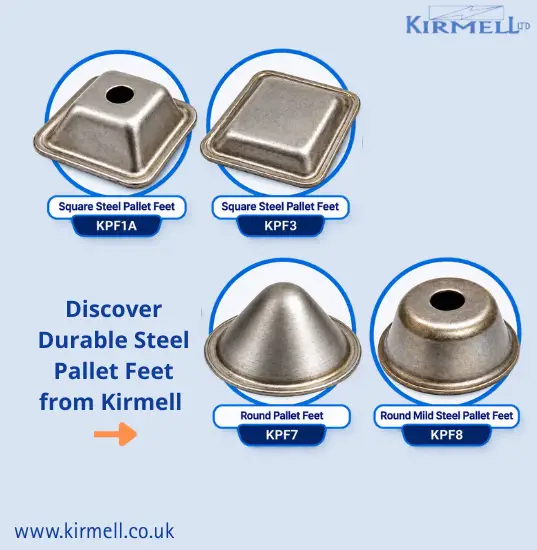
Pallet feet are essential for stability, load distribution and safe handling. They support the pallet structure, provide clearance for forklifts and pallet trucks, and help keep stacked pallets secure. The right foot design can also improve performance under heavy loads and repeated industrial use.
Kirmell manufactures and supplies pallet feet for steel pallets and stillages, with options designed for different pallet designs, load requirements and stacking applications. Choosing the right pallet feet can help improve stability, handling efficiency and the service life of the pallet.
Benefits of Steel Pallets
Steel pallets offer several advantages for industries that need strong, reusable and reliable handling equipment. Their benefits go beyond load capacity, covering durability, hygiene, automation and long-term value.
- Durability & long lifespan: Steel pallets can withstand repeated handling, impacts and demanding industrial conditions without easily cracking, splintering or breaking.
- High load-bearing capacity: Strong steel frames, decks and supports allow pallets to carry heavy loads, including machinery, automotive parts and metal products.
- Resistance to pests, moisture, fire & chemicals: Steel does not absorb moisture or attract pests, is non-combustible, and can be protected against corrosion and chemicals with suitable finishes.
- Reusability & lower long-term cost: Their long service life and ability to be reused and repaired can reduce replacement costs over time, despite a higher initial price.
- Recyclability & sustainability: Steel can be recycled at the end of its service life, while its durability reduces the need for frequent pallet replacement.
- Dimensional consistency: Steel pallets maintain their shape and dimensions during repeated use, making them suitable for conveyors, automated warehouses and robotic handling.
- Hygiene: Smooth, non-porous steel surfaces are easier to clean, while stainless steel versions are well suited to food processing, pharmaceutical and other hygiene-sensitive environments.
Steel Pallets vs Wood & Plastic Pallets
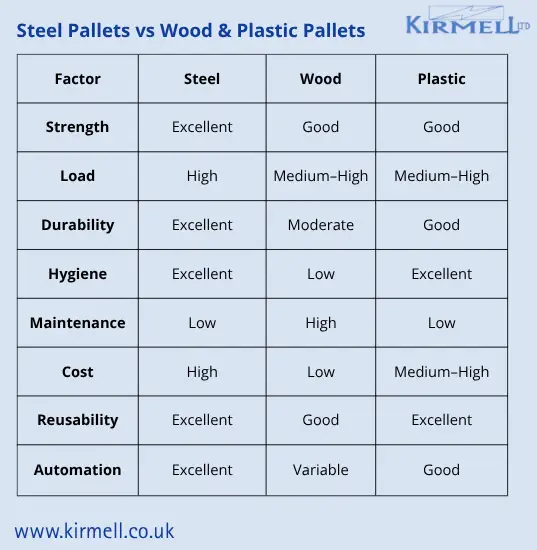
Metal pallets, wood pallets and plastic pallets each have their place, but their performance can vary significantly depending on the application.
The table below compares the key factors to consider when choosing between them.
Industrial Applications
Steel pallets are used across industries where strength, durability, hygiene and reliable handling are important. Their ability to carry heavy loads and withstand repeated use makes them suitable for both storage and transport.
- Automotive manufacturing: Used to store and move heavy components such as engines, transmissions, metal parts and other automotive assemblies.
- Warehousing & logistics: Suitable for heavy goods and returnable transport systems, including steel cage pallets for contained loads, as well as automated storage and retrieval systems (AS/RS), conveyors and robotic handling.
- Food & beverage industry: Stainless steel pallets are useful in hygiene-critical environments because their smooth surfaces are easier to clean and sanitise.
- Pharmaceutical industry: Stainless steel designs can support controlled storage and handling where cleanliness, corrosion resistance and easy sanitation are important.
- Steel & metal fabrication: Used for transporting raw materials, fabricated parts, pipes, metal sheets and other heavy components around production facilities. In environments handling drums and liquids, drum steel spill pallets can also provide a durable platform with spill containment.
- Export & international shipping: Steel pallets can withstand repeated handling and long-distance transport. Unlike wooden pallets, steel pallets do not require ISPM 15 heat treatment or fumigation, making them useful for international supply chains.
How to Choose the Right Steel Pallet
The right steel pallet depends on more than the weight of your goods. Consider how the pallet will be used, stored, handled and reused before choosing a design.
- Load capacity needs: Start with the weight and type of goods you need to carry. Consider both static and dynamic loads, as well as how evenly the load will be distributed across the pallet.
- Storage environment: Consider whether the pallets will be used indoors or outdoors, exposed to moisture or chemicals, or operated in an automated warehouse. Galvanized steel pallets can be a suitable option where additional corrosion protection is needed. The shape and design of the pallet feet can also affect stability in different storage setups.
- Budget vs. lifecycle cost: Steel pallets usually have a higher upfront cost than wooden pallets, but their longer service life, reusability and repairability can provide better value over time. Compare the total cost of ownership, not just the purchase price.
- Custom vs. standard sizing: Standard pallet sizes can be more cost-effective and easier to integrate with existing handling systems, but pallet feet size and placement should also match the pallet design and load requirements. If you handle oversized, unusually shaped or heavy products, a custom steel pallet may provide better support and handling efficiency.
Frequently Asked Questions
Steel pallets are used to store, transport and handle heavy goods. They are common in manufacturing, automotive, warehousing, construction and logistics.
It depends on the design and construction. Standard steel pallets may handle hundreds of kilograms, while heavy-duty models can support several tonnes.
For heavy-duty and repeated use, steel pallets can be better because they are stronger, more durable and resistant to moisture, pests and fire. Wooden pallets are usually cheaper upfront.
Yes. Steel pallets can be used outdoors, especially when they have galvanised or protective coatings to reduce corrosion.
Standard steel pallets are generally more affordable and suitable for general industrial use. Stainless steel pallets offer better corrosion resistance and hygiene, making them suitable for food, pharmaceutical and other sensitive environments.
Yes. Steel pallets can be made to custom dimensions, load capacities and configurations, including special feet, posts, forklift openings and lifting points.
Yes. Steel is highly recyclable and can be recovered and reused when the pallet reaches the end of its working life.
There is no fixed lifespan because it depends on the load, handling and environment. With proper use and maintenance, a steel pallet can last for many years and be reused repeatedly.
Conclusion
Steel pallets are a strong choice when you need durability, high load capacity and long-term reuse. They are especially useful for heavy industrial loads, demanding environments, automated handling systems and applications where hygiene or fire resistance is important.
However, not every steel pallet is suitable for every job. The right choice depends on the pallet design, load capacity, dimensions, feet, surface finish and handling configuration. By matching these features to your specific application, you can improve safety, storage efficiency and the overall service life of your pallets.